
Google Ads are one of the fastest ways to place your clinic in front of patients actively searching for a doctor, treatment or medical service.
You set a budget, decide which treatments or concerns to advertise, prepare your advertisements and pay whenever someone clicks through to your website.
When you run Google Ads, there is only one meaningful goal:
Generate genuine enquiries, appointments and patients—while remaining HCSA-compliant, of course.
Every click spends part of your advertising budget. For the campaign to make commercial sense, the patient value and profit generated must justify what you spend.

Google Ads and AI visibility perform different roles:
The strongest healthcare search strategy does not choose between Google Ads, SEO and AI visibility. It uses each channel for the part of the patient journey it is best positioned to influence.
Others say it is identifying your clinic’s key selling points.
Both are important—but neither is the first question.
The first and most important step is determining whether your practice is commercially suitable for Google Ads.
Not every medical practice can achieve a healthy return through SEM.
Healthmark frequently sees strong potential among:
Google Ads may be more challenging for:
This does not mean Google Ads can never work for these practices. It means the economics, patient search behaviour, service mix and expected patient value must be assessed carefully before committing budget.
Medical advertising can be expensive. Depending on the specialty and level of competition, each click may cost between $7 and $30.
With a $2,000 budget, that may give you approximately 66 to 285 clicks.
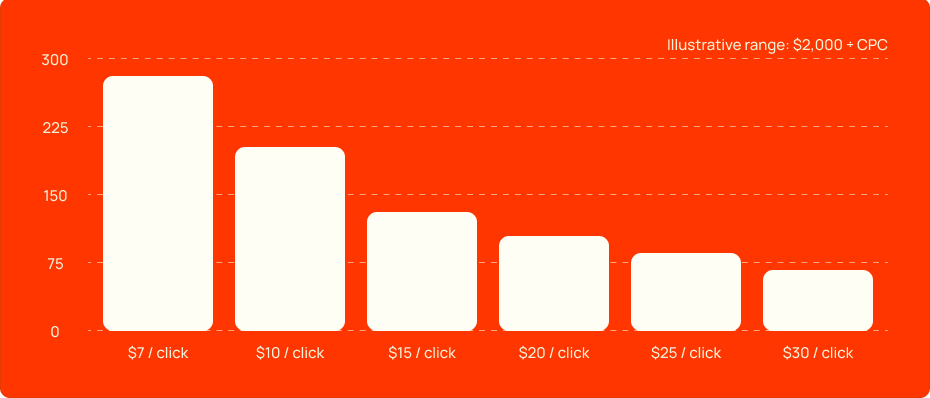
To generate a sustainable return from those clicks, your services should ideally have sufficient patient value, margin or lifetime value.
These are commonly:
For example, a family clinic earns primarily through consultations and medication. The margin from each new patient may be too low to comfortably support an $8 to $16 click.
There is also limited reason for a patient with a common illness to travel across Singapore to visit a particular family clinic.
In comparison, basic diagnostics performed by an ophthalmologist or ENT specialist may already produce a patient bill of approximately $300.
For gastroenterologists, upper gastrointestinal surgeons and colorectal surgeons, a double scope may generate between $2,000 and $5,000.
Psychiatry is another example. Although revenue may come mainly from consultations, the lifetime value of a patient requiring multiple appointments can be considerably higher.
The mathematics must make sense before the campaign begins.
From the beginning, Healthmark can advise you on:
You do not want to spend $8,000 to $15,000 over three months only to hear:
“This particular treatment does not perform well through Google Ads.”
Some treatments and services simply do not respond well to SEM.
Healthmark helps you avoid known dead ends and allocate your budget towards searches with a more realistic path to patient acquisition and profitability.
The questions that matter most are:
A campaign should not be considered successful simply because it has a high click-through rate, strong Quality Score or prominent ad position.
It is successful when it generates commercially valuable patients at a sustainable cost.
The most important KPIs include:
Clicks, impressions and ad position provide useful context—but they should never be mistaken for business results.
Not every clinic needs a bigger advertising budget. Some just need a smarter strategy.
Let's find out how Google Ads can work harder for your practice.


